
The Official Dad Token Resource Hub
Thank you for purchasing The Dad Token System. As a reminder, this is a slightly overcomplicated but fun economy of rewards (available only on Etsy). It is loosely inspired by a certain beet-farming paper salesman.
This page is your companion guide to The Dad Token System. Below you’ll find the extended instructions and resources for the files in your kit.
Check Your Inventory
Per the “Welcome & Instructions” sheet in your download, your kit contains three core components:
Setup & Printing (The “DIY” Guide)
As mentioned in Step 2 of your instructions, you have two ways to create the tokens:
Option A: The Cardstock & Cut: Print the token pages on heavy cardstock. Use a pair of scissors to cut them out.
Option B: Print on Labels: I designed the tokens to fit on 1.5-inch round labels (which then fit on standard sized poker chips).
- Buy a pack of 1.5″ Circle Labels from Amazon. I used these labels because I felt they were the best bang for the buck.
- Print the token pages directly onto the label sheet.
- Stick them onto standard poker chips.
- Optional: If you don’t want to do all this work, let my household do it for you!
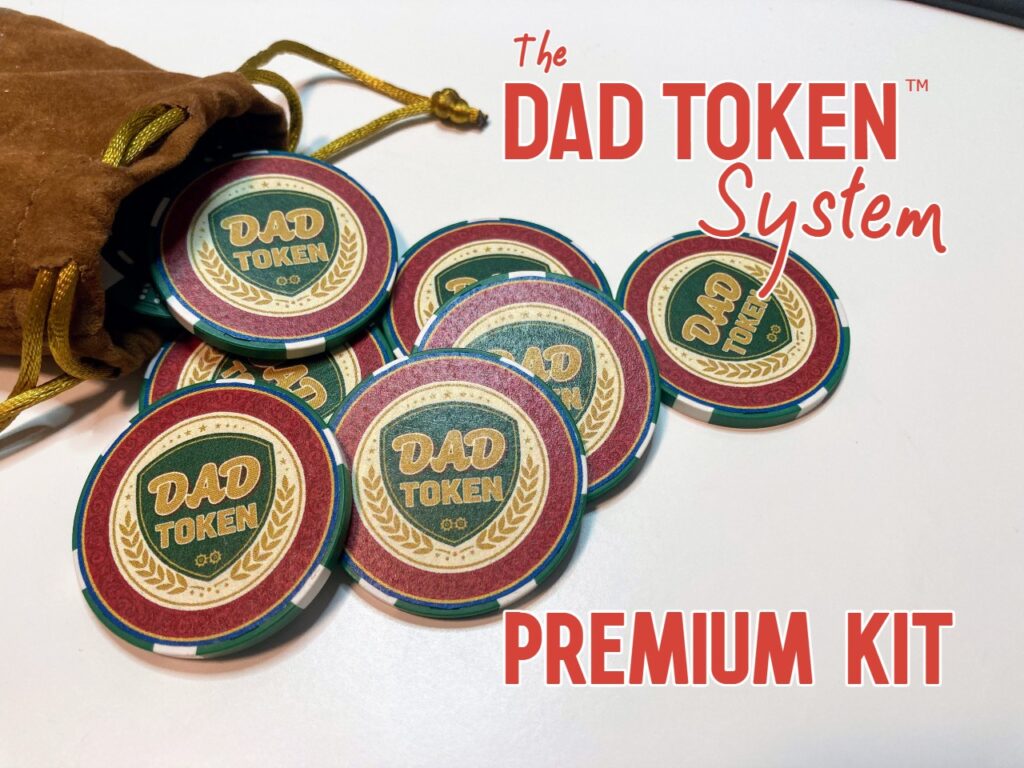
Skip the Printing & Cutting
Get the full system delivered to your door. Launching Nov 29 (Small Business Saturday)!
With The Dad Token System Premium Kit, you’ll get the system ready to go out the box. Each kit is hand-assembled by the “Fickle Father Fulfillment Team” (i.e. my kids). Your purchase directly supports their college funds (and LEGO habits).
The Exchange Rates & Logic
The system runs on a 3-tier economy designed to teach delayed gratification.
- Tier 1: Dad Chips. These are for high-frequency tasks like “Ready on Time” or “Bed Made.” They flow fairly freely.
- Tier 2: Dad Tokens. 4 Dad Chips = 1 Dad Token. Kids must save their Dad Chips to “buy” a Dad Token. This is where they learn planning.
- Tier 3: Tokens of Appreciation. 1 Dad Token = 2 Tokens of Appreciation.
The separate reward tracks further help them learn the important of planning and saving. For example, if they want to do a lunch outing to sushi, they can’t keep redeeming their tokens for video game time.
Adjust as You Go.
You may have to adjust rewards and values as you go. You have to find a mix of things that motivate and inspire your kids to earn those chips and to make choices. If a reward is too easy to get, raise the price. If a chore is too hard, you may consider offering more chips. If a reward becomes too taxing, you might replace it with something else. The goal isn’t a perfect system; the goal is establishing a fun system that builds connection.