
As parents, most of us tell our kids, “Use your words.”
But often, the problem isn’t that kids won’t use their words — it’s that they don’t have the words yet. Or, they don’t understand what they are feeling well enough to articulate those feeling into words. (Quite frankly, this is probably also true for many adults … It was for me for a long time).
Before kids understand their emotions, they will first feel them somewhere in their bodies. Only later do they learn what those feelings are called and what they mean.
Learning to understand and use your emotions as signals of information is an essential part of developing into a person would can self-regulate and face life’s challenges with resiliency.
Isn’t that what we all want?
Core and Secondary Emotions
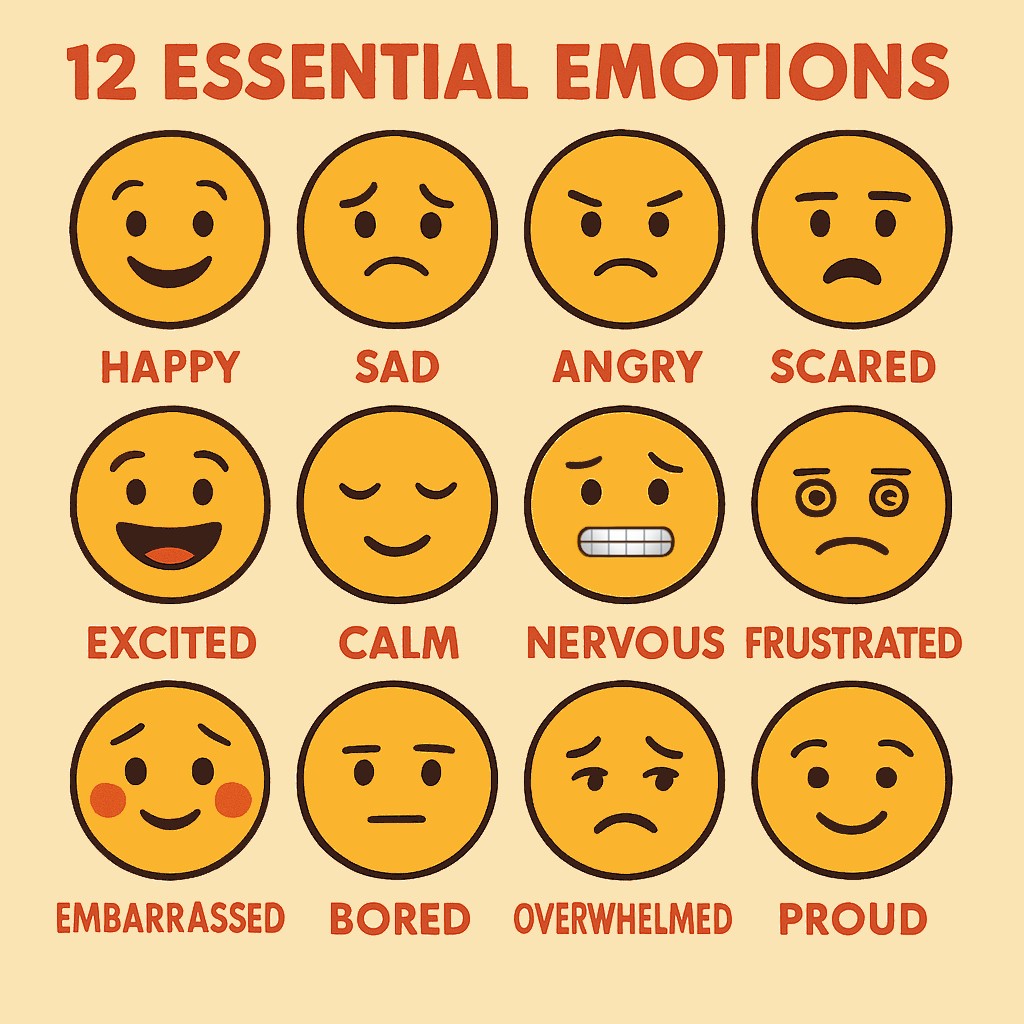
The list of emotions I am providing include six “core” emotions and six “secondary” emotions (for a total of 12).
Core (or primary) emotions are the feelings we’re born with. They are:
- Universal across all cultures
- Hardwired into the nervous system
- Fast and automatic
- Felt in the body before the mind understands them
Secondary emotions are more complex. They are shaped by:
- Experiences
- Thoughts
- Social expectations
- Learned patterns
- Meaning the child gives to a situation
Examples include frustration, embarrassment, loneliness, jealousy, boredom, anxiety, and shame. Secondary emotions help kids express what’s happening inside their relationships or social structures, not just inside their bodies.
Candidly, there does not appear to be a strong consensus on what emotions should fit into core or secondary groupings. So I put this in an order that makes sense to me. Whether an emotion is correctly labeled is not as important as the fact that we can learn about the emotion regardless of its label.
Hopefully you can use this list in your home as a tool for connection, emotional literacy, and self-regulation.
The 12 Essential Emotions
1. Happy
In the Body: Warm chest, relaxed shoulders, easy smile
Signals: Something feels good or connected
Ask: “What made you feel good today?”
2. Sad
In the Body: Heavy chest, lump in throat, slower movement
Signals: Something important feels lost or missing
Ask: “What were you wishing for?”
3. Angry
In the Body: Tight jaw, hot face, clenched fists
Signals: A boundary was crossed; something feels unfair
Ask: “What felt wrong or not okay?”
4. Scared
In the Body: Tight stomach, shaky hands, cold skin
Signals: Your brain sees a possible danger
Ask: “What did your brain think might happen?”
5. Excited
In the Body: Bouncy legs, fast talking, butterflies
Signals: Something good is coming
Ask: “What are you looking forward to?”
6. Calm
In the Body: Slow breath, soft eyes, loose muscles
Signals: Safety, regulation, and emotional fullness
Ask: “What helped your body get to this calm place?”
7. Nervous
In the Body: Tight belly, fidgeting, sweaty palms
Signals: You care about doing well
Ask: “Does this matter to you? Is that why you feel nervous?”
8. Frustrated
In the Body: Tension in shoulders, sighing, clenched fists
Signals: You’re trying hard but something keeps blocking you
Ask: “What were you trying to do? What got in your way?”
9. Embarrassed
In the Body: Hot cheeks, shrinking posture, avoiding eye contact
Signals: You want to belong, and something felt awkward
Ask: “Did it feel like people were looking at you?”
10. Bored
In the Body: Heavy stomach, slumped posture, restless, heavy
Signals: You need connection or engagement
Ask: “What are you wanting right now — something fun, something challenging, or someone to do something with?”
11. Overwhelmed
In the Body: Slumped shoulders, racing mind, tired muscles
Signals: Too many demands at once; need for a pause
Ask: “What feels like too much right now?”
12. Proud
In the Body: Upright posture, bright eyes, warm chest
Signals: You did something brave, meaningful, or skillful
Ask: “What did you do that took courage or effort?”
How to Use This List With Your Kids
1. Pick a Month, Pick an Emotion
I created this list of 12 emotion with the idea that you could take one each month to focus on. For example, in January you would teach about being happy, how that emotion is felt, and what it might signal.
In February, you would teach about the emotion of feeling sad.
In this way, during 2026, you and your children will be actively working on building a vocabulary of emotion.
2. Teach the Body First
Kids understand physical sensations before abstract ideas.
Ask: “Where do you feel that in your body?”
3. Normalize Every Emotion
No emotion is bad.
Every emotion is information from the nervous system. Our emotions can attune to the world around us sometimes much faster than our brains. They are signals you can process to understand important information about the world around you.
It’s like your body saying, “Hey! Something is happening. Pay attention!”
4. Use the Conversation Starters
Your goal is to open the door to help them to share so you can understand, without judgment, why they are experiencing this emotion.
You may have to experiment to see what works best for your person. It may be asking where they feel it in the body. It may be using the conversation prompt.
But the hope is that you can create a safe space and they will fill it.
5. Reflect Back What You Hear for Understanding and not Judgment
Say:
- “That makes sense.”
- “I can see why you’d feel that.”
- “Thanks for telling me.”
Validation builds trust.
You can share your opinions, problem-solve, and teach once you have an understanding of the emotional backdrop.